Hunt Club is a single-family subdivision in Oswego that a 2014 Patch roundup places south of Route 71 and east of Minkler Road. It describes homes by Town and Country Homes and K. Hovnanian Homes, begun in 2007, of roughly 2,052 to 3,238 square feet. The Village lists Hunt Club among the subdivisions south of Mill Road. This page is for owners who have water in a larger house.
Why house size matters for drying
A larger house usually means more rooms, more drywall and more flooring in the path of the water. A leak on an upper floor can drop through a ceiling into a finished room below. A leak in a lower level can wet a long run of wall base. We do not say large homes suffer more damage. We say the plan has to cover more area.
| Where the water started | How far it can travel | What we check |
|---|---|---|
| Upstairs bathroom or laundry | Through the floor into the ceiling below | Ceiling cavity, light fixtures and wall cavities. |
| Kitchen or dishwasher line | Across flooring and under cabinets | Cabinet bases, subfloor and adjoining rooms. |
| Lower level or utility room | Along walls into finished rooms | Wall base, carpet pad and framing. |
Structural drying in a large house
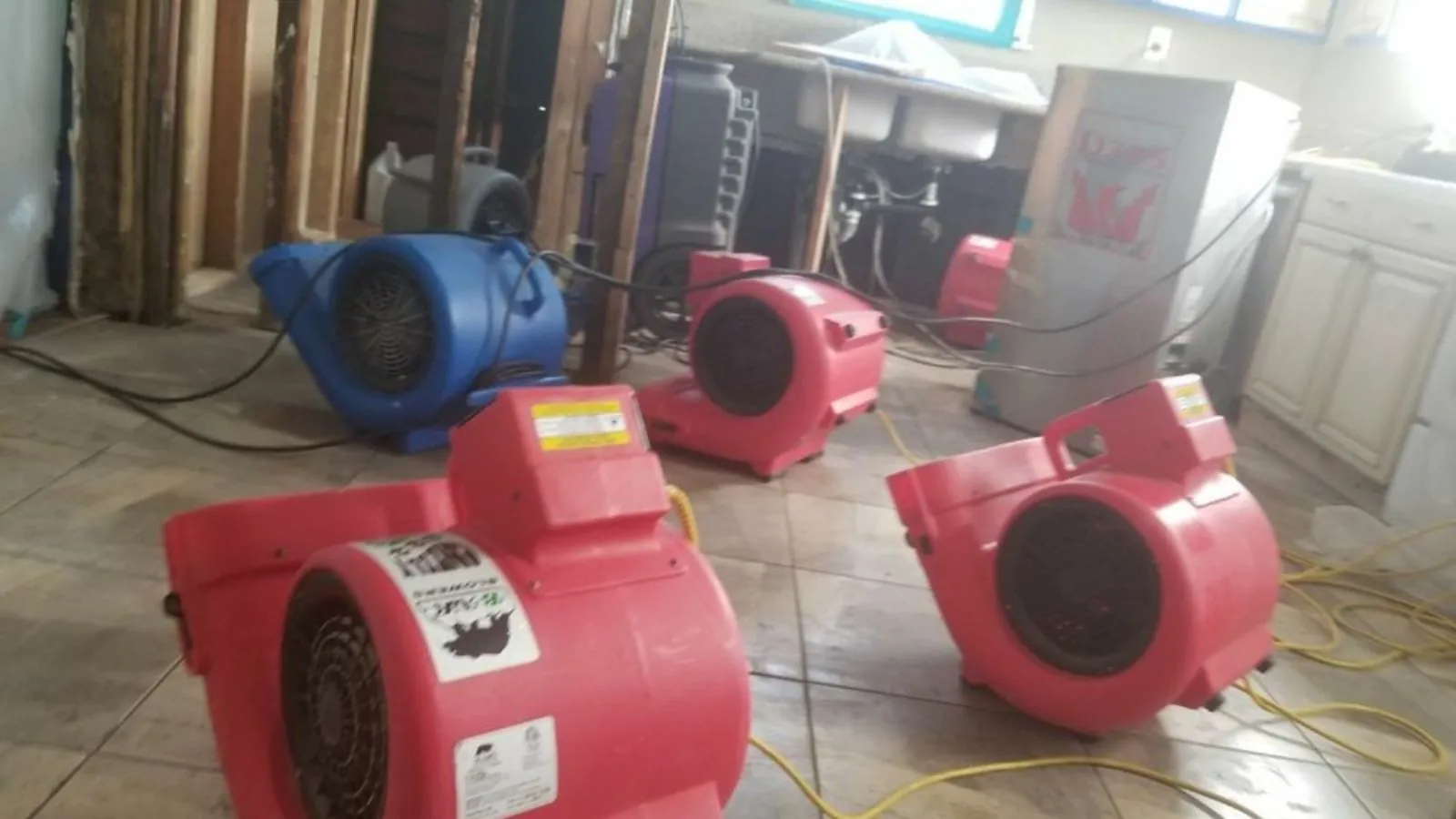
Drying a big house is a process, not a single step. We extract standing water, then place air movers and dehumidifiers according to what the readings show. Each visit we measure again and move equipment. We stop when readings match an unaffected reference. Our structural drying page explains the stages.
- Find the source and stop it.
- Extract standing water.
- Remove materials that cannot be dried.
- Dry the structure with equipment sized to the rooms.
- Record moisture readings until the structure is dry.
What we know about the area
Hunt Club homes date from 2007 onward, so they are not old, and we have no evidence that any particular kind of damage is common there. Neighborhood-specific FEMA flood-zone status not verified for Hunt Club. The Village identifies the Fox River and Waubonsee Creek as its main flood hazard areas, and a lender or the Village can check a single address.
Safety before you start cleanup
If you smell gas, leave and call Nicor at 888-642-6748, then 911.
- Keep out of rooms where water meets outlets, cords or appliances.
- Do not stand under a ceiling that bulges or sags.
- Do not use a household vacuum or ceiling fans on wet areas.
- Photograph the damage before moving items.
Documenting a bigger loss
A larger loss means more rooms to describe, so keep the record organized. Photograph each room and each wet surface, write down what was wet, and keep dated moisture readings and receipts. Coverage depends on your policy and the cause, and we do not decide it. Read your policy for water backup and flood wording, which are often separate.
Drying a larger house follows the IICRC S500 standard, with equipment placed by room and readings taken at each visit. The standard is a reference we follow, and it does not mean anything more than that about our credentials.
Hunt Club contacts
For a water main or street leak, call Village of Oswego Public Works at (630) 554-3242.
Call Village of Oswego Building and Permits at (630) 554-2310 about repair permits.
The Illinois Department of Insurance answers consumer coverage questions at no charge.
Read about kitchen water damage or ceiling water damage if either matches your situation. The service area page lists the rest of our coverage.
Questions from Hunt Club homeowners
We have not verified that for the subdivision. A property-level check with the Village or FEMA is the reliable answer.
Often, because more rooms and materials are involved. Drying time depends on the water, the materials and the readings, so we cannot give a fixed number.
Usually yes when the water was clean and found quickly. Wet carpet pad and drywall that stayed wet are often removed.
We answer calls across Oswego. Call with your street address and we will confirm coverage.
The source of the water, then each wet room and surface, taken from a safe spot before you move anything.